2006/07/10

Diplomacy isn't working

By Robert HowardThe Hamilton Spectator(Jul 4, 2006)
Huseyincan Celil is a Canadian citizen believed to be in a jail cell somewhere in China. It is outrageous that a foreign government will not even say whether it has a Canadian in prison.
China is not even acknowledging it has the Burlington resident. His wife isn't sure he is still alive. That's utterly unacceptable and Beijing must be informed, in the strongest possible language, that Canada will not tolerate denial of basic human rights to Canadian citizens.
China is a trading superpower, which influences how tough other governments are in confronting it on its appalling human rights record. But Ottawa must insist, inside or outside traditional diplomacy, that Canadians are treated in accordance with international standards of justice.
Citizenship doesn't provide immunity against arrest or imprisonment in another country. But it must ensure Ottawa will go to bat for its citizens -- insisting on such basic rights as competent counsel and a fair and transparent judicial process.
Celil is accused by his native China of working for a violent separatist movement in Xinjiang province. He escaped China and received refugee status and later citizenship in Canada. Sentenced to death in absentia by a Chinese court, Celil was arrested in March in neighbouring Uzbekistan.
Uzbekistan says he has been sent to China. Beijing is saying nothing.
This is all-too-familiar ground for Ottawa:
* William Sampson was imprisoned without a lawyer, brutally tortured and sentenced to death in Saudi Arabia in 2001. Released in 2003.
* Canadian Zahra Kazemi died in Iran during interrogation after being arrested taking photos outside a prison. A medical witness says she was brutally tortured and raped and died of head injuries. No autopsy was ever allowed and the only person ever charged in her murder was acquitted.
* Maher Arar is a Syrian-born Canadian who was held as a terrorism suspect for a year without charges in a Syrian jail.
Diplomacy is traditionally based on notes and niceties. A rapid non-traditional response -- perhaps even a phone call from the Prime Minister's Office to one of Beijing's aging despots -- may be needed to save another Canadian from torture or death. Ottawa needs to act.

Quote of the Day

Harper gets plea to save Canadian

PM to aid detainee in China

Kyrgyzstan: human rights activists stage a picket in front of the Embassy of China


Friday , 07 July 2006
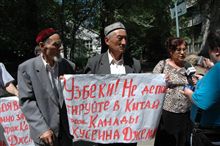
Activists of the Uigur diaspora of Kyrgyzstan and local human rights community staged a picket in front of the Embassy of China in Bishkek on July 5.Protesters' first demand concerned citizen of Canada Huseyincan Celil detained by the Uzbek authorities this March and extradited to China where he was wanted as a religious extremist [see Ferghana.Ru report on June 28]. The Uigurs and human rights activists demanded his release. They also demanded to put an end to harassment of the family of Rabija Kadyr, the head of the Uigur Association in the United States.
The demands to Chinese Chairman Hu Jintao were turned over to Embassy officials, a copy was sent to UN Secretary General Kofi Annan.

China’s Islamic Frontier

On June 27 the government of Uzbekistan transferred Huseyincan Celil, now a Canadian citizen, to Chinese custody to await execution. While authorities of the People’s Republic of China charge that Mr. Cecil is guilty of killing Chinese delegates in Kyrgyzstan in 2000, the evidence suggests that Cecil was in fact in Turkey at the time under the direction of the United Nations High Commission for Refugees. The Toronto Star noted that the man “was sentenced to death in absentia for founding a political party to work on behalf of the Uighur people in Xinjiang province.” Beijing’s insistence on the execution of a man who is likely to be purely a human rights activist is not difficult to explain, but rather illustrative of the anxiety the Chinese Communist Party maintains over the country’s Muslim west.
If China’s west is to be won, it will largely take place in the following decade. The Xinjiang Autonomous Uighur Region, located in China’s northwest, is home to approximately eight million Uighur Muslims – there are several million Hui, Kazakh, and Tajik Muslims as well – and is the likely flashpoint should any ethnic separatist movement threaten the mainland’s territorial integrity. The region’s most radical group, the East Turkistan Islamic Movement (ETIM), not only has ties to al-Qaeda, but is also providing the government in Beijing with a pretext for solidifying their control over the province’s Uighur population.
The vast majority of the limited debate that has occurred in the United States on this matter has mistakenly focused on the question of whether the Chinese do indeed have a terrorist problem, and in either conclusion, whether the CCP has manipulated the situation to consolidate their hold on the country’s restive population. While both issues must be taken into account when examining the situation in Xinjiang, the aspect that best encompasses the question of China’s Islamic west is the frontier factor.

The total population of Xinjiang remains relatively sparse. Of China’s 1.3 billion people, only about 20 million live in Xinjiang despite the fact that the province constitutes about one-sixth of China’s total landmass. The region’s expanding importance to China’s economy, the Islamic presence in the region, and the threat of separatist and terrorist organizations have led Beijing to conclude that the country’s northwestern frontier must be tamed.

The government’s handling of their Muslim citizens in the Chinese west has been both authoritarian and effective. Under the “Strike Hard” campaign begun in the mid-nineties, those who have studied in madrassahs abroad are monitored by Chinese authorities, and all material considered subversive is confiscated at the border from those returning from the Central Asia or the Middle East. Executions of suspected terrorists are frequent, while arrests are often made for the slightest potential infraction. Last year more than 18,000 were arrested in Xinjiang for what Beijing classifies as “endangering state security.”

As is the case with all religions in China, few decisions by Muslim leaders are made independent of CCP interference. There is one Islamic seminary in China and all imams must be graduates of this state-run institution. Imams are employees of the state and few actions are conducted without supervision by the official security apparatus or their informers. Such efforts are not limited to Chinese territory. About 350,000 Uighur immigrants live in neighboring Kazakhstan and Kyrgyzstan, and Beijing has called on these Central Asian states to maintain a firm control of these populations to ensure that none come to pose a threat to China’s hold on Xinjiang.

The People’s Republic of China is among the world’s foremost violators of human rights. This has created a dilemma for Washington in both conducting the war on terror and in its relations with Beijing. In a diplomatic row between the two countries in May, Chinese officials harshly condemned the United States’ decision to send five Chinese Muslims detained at Guantanamo Bay to Albania rather than back to their home country. Foreign ministry spokesman Liu Jianchao revealed his displeasure when he noted: “This act by the US and Albanian sides is a gross violation of international law and we are strongly opposed to this.” Pressure from Beijing was so strong not to accept these Chinese citizens that Albania was the sole country of more than twenty not to be intimated by the PRC’s demands.

In a piece in The Wall Street Journal on June 27, Uighur human rights activist Rebiya Kadeer detailed the nefarious methods used by the PRC in maintaining their uncontested authoritarian rule over Xinjiang. Ms. Kadeer was arrested in 1999 for sending newspaper clippings to the United States and planning to meet with a U.S. congressional delegation in the Xinjiang capitol of Urumqi. After the Bush administration secured her release in March 2005, a stern warning was issued. “Before I left Beijing, Chinese officials warned me that if I spoke out against the plight of the Uighurs, my children and my business would be ‘finished,” wrote Kadeer. Earlier this month Chinese authorities followed through on their word when they beat Ms. Kadeer’s children – allowing the female to call the mother during the beatings so she could hear the suffering – and latter arrested the three on charges of “plotting to split the state” and tax evasion.

While China’s leadership may falsely categorize those seeking human rights and greater autonomy as terrorists, and their methods of control fail to follow acceptable norms, it is clear that the PRC faces a real and legitimate terrorist threat. Islamists in Xinjiang maintain extensive ties to international terrorist organizations, including al-Qaeda. The leading terrorist organization, the East Turkestan Islamic Movement (ETIM), maintains communications with jihadist groups in Iraq and Afghanistan. Some of its more experienced members fought with the mujahadeen against the Soviets in Afghanistan, and safe houses and cells have been uncovered everywhere from Germany to Pakistan. In fact, in late June, Chinese diplomats in Pakistan wrote the Ministry of Foreign Affairs that they had information that members of ETIM were operating in Pakistan and maintain plans to kidnap them.

Not only do Xinjiang Islamists operate in a diverse variety of states, but foreign extremists have sought refuge in the radical sectors of China’s Uighur community as well. Chinese authorities have captured Taliban militants in Xinjiang, and there have been reports that the Islamic Movement of Uzbekistan maintains a cell in the province. It is also worth noting that outside terrorist groups come to Xinjiang not because of a perceived regional lawlessness, but because they expect to find elements in the Muslim community that will harbor them.

Extremist groups in Xinjiang also look to foreign terrorist organizations to draw inspiration for their propaganda efforts. According to Rohan Gunaratna and Kenneth George Pereire in the most recent issue of the China and Eurasia Forum Quarterly, “ETIM, and associated groups, have learned from groups, such as the Chechen terrorists, to exploit Western human rights and humanitarian associations, to assist various activities.” Thus, the organization’s principle propaganda outlet is strategically based in Munich where the group hopes to capitalize on European liberalism.

On occasion ETIM has released videos that appear to emulate those produced by al-Qaeda. Footage of the airliners crashing into the World Trade Center has been celebrated in these videos and one such propaganda piece claims that the group has brought down a Chinese plane. While this claim has not been substantiated and is likely a fabrication, some analysts believe that the PRC’s efforts to contain ETIM’s profile – as well as limit the dissemination of information that could discourage human and capital investment in the region – provide for the possibility that such an event could have occurred.

The Chinese labeled ‘three evils’ of terrorism, separatism, and extremism may be a burden to the leadership in Beijing, but they also play to the CCP’s benefit. Chien-peng Chung, an Assistant Professor of Politics at Lingnan University in Hong Kong, noted in CEF Quarterly: “For all their collective malfeasance, it must be admitted that the ‘three evils’ offer rather good mass media propaganda for the PRC government to keep ethnic demands on the defensive, dismiss foreign scrutiny … and perhaps most importantly, sustain the unity of the Han Chinese ethnicity.”

The Han Chinese – the national majority constituting 92 percent of China’s population – are just beginning to settle China’s northwest in large numbers, but the demographics of Xinjiang have already greatly been altered in the last half-century. As was noted by the BBC, in 1950 Uighurs made up 94 percent of Xinjiang’s population, whereas today they are estimated to be just less than half. Nevertheless, Chinese officials maintain that they possess no plans to dilute the influence of Muslim Uighurs in the province as one official recently suggested: “There's very little difference in the ethnic balance between now and the early 1950s,” and Beijing’s encouragement of westward migration “certainly isn’t an issue of moving Han people to Xinjiang.”

Beijing’s lack of sincerity in their statements regarding the demographic implications of the Han Chinese settlement of the country’s northwest frontier is an inevitable result of the government seeking to avoid alarming Xinjiang’s Uighurs. The state has taken measures to contain any such future developments where “reactionary” elements may attract widespread support. This is largely being accomplished by Han migrations to Xinjiang. As Chien-peng Chung stated in his aforementioned work, “the government has been promoting an unstated but deliberate policy of ethnic encirclement by authorizing Han settlements in neighborhoods separate from, but close to, Uighur” communities.

The emphasis on maintaining a firm grip on the situation in Xinjiang is not only aimed at preventing a popular secessionist movement, but it also represents a concerted effort to ensure the economic stability of the region. The province of Xinjiang is becoming increasingly important to China’s economic growth, and its geographic location bordering Central Asia and Pakistan ensures the region’s vital role as a gateway for energy resources. While the Xinjiang is a significant producer of domestic coal and oil, it is also essential for the expanding quantities of oil and natural gas imported from Central Asia that must pass through the province on their way to China’s high consumption eastern cities. With Beijing’s efforts to secure energy resources across the globe, it is doubtful they will ease their grip on Xinjiang anytime soon.

China is settling its west and is likely to achieve success in bringing both economic prosperity and repression of regional autonomy to Xinjiang. Beijing and the region’s Islamic terrorists will continue to clash, and as Henry Kissinger stated during the Iran-Iraq War, it’s a shame they both can’t lose. But one thing is for certain: there will be many more Huseyincan Celil’s caught in the struggle for China’s Islamic frontier.

China: More Security for Envoys in Region


By ILAN GREENBERG
Published: July 4, 2006
Chinese officials have urged Central and South Asian countries to increase security for Chinese diplomats after the deportations of Uighurs to China from neighboring countries. Uzbekistan announced last week the deportation of Huseyincan Celil, a Uighur in exile from China. Beijing says he is a member of the East Turkestan Islamic Movement, which it calls a terrorist group. Mr. Celil was arrested in Uzbekistan in March and faces the death penalty if put on trial in China. In May, Kazakhstan deported two Uighurs to China to face charges of terrorism and sedition. Uighurs, who are Muslim, are half the population of Xinjiang Province, on the border with Kazakhstan.

Update on Uyghur in Uzbekistan, Husein Dzhelil or Celil


I received this from Canada's Ministry of Foreign Affairs, in response to my letter about Husein Celil. This is the first time I have received a response from authorities when I've written about a prisoner of conscience. Of course the difference here is that Canada is not the perpetrator in this case, but rather trying to free Husein Celil. Still, I am impressed that Canada took the time to respond to me. Here you can read about Husein Celil and email/mail your own letters on his behalf, to Canada (where he is a citizen) and Uzbekistan (where he is being held and likely to be extradited to China for execution).
I would be curious to hear whether other activists have received responses from authorities concerning any human rights concerns.
________________________________________
Ottawa, Ontario
K1A 0G2

May 15, 2006

Ms. Celia Llopis-Jepsen

Dear Ms. Llopis-Jepsen:

This is in response to your email of April 26, 2006, in which you
express concerns regarding the detention of Mr. Huseyincan Celil, in Uzbekistan.

I wish to assure you that officials of Foreign Affairs Canada in
Tashkent, Uzbekistan, in Moscow, Russia, and in Ottawa, are aware of Mr. Celil's case and have been working tirelessly towards a resolution. Officials are actively continuing their diplomatic efforts and are in regular communication with Mr. Celil's family.

The Consular Affairs Bureau is mandated by the Privacy Act, which
prohibits the disclosure of personal information by a government department or agency unless the consent of the individual(s) who are the subject of the information has been obtained. Any personal information cannot be disclosed to unauthorized parties without the explicit consent of the individual(s) concerned.

As you can appreciate, the Canadian government has a legal obligation to safeguard the privacy of Canadian citizens. We would like to stress, however, that the Government of Canada is pursuing this matter very seriously in order to bring an end to Mr. Celil's detention in Uzbekistan.

Thank you for writing and taking the time to express your concerns.

Yours sincerely,


Janice Hayes
Director
Ministerial Correspondence Division

2006/07/07

Family losing hope for missing Canadian


Harper has yet to respond, they say
Ex-activist may be in Chinese prison

Jul. 5, 2006. 10:44 AM

JESSICA LEEDER AND HEBA ALY

STAFF REPORTERS

After 100 days since Huseyincan Celil was taken into foreign custody, questions still swirl around his disappearance, his whereabouts and the Canadian government's response.

The Chinese-born Muslim refugee is a Canadian citizen and father of six who has been shuttled between captors so secretively that his family isn't even sure he's still alive.

Aside from comments from Foreign Affairs Minister Peter MacKay that his office began trying months ago to secure Celil's release, Ottawa has barely acknowledged the fact the Burlington imam and former political activist is a prisoner whose prospects turned grim when he apparently surfaced in Chinese custody last week. He faces a death sentence there.

Prime Minister Stephen Harper has not responded to a letter sent last week by Celil's Hamilton-based lawyer, Chris MacLeod, requesting he send a special envoy to secure Celil's release. Harper's help, Celil's family says, is their only hope.

Sandra Buckler, Harper's spokeswoman, said the letter was received. She could not say how long it will take Harper to respond, adding that response time varies depending on how many ministries are involved.

The case against Celil, who became a Canadian citizen last year, is confusing and complex. It involves allegations that he has multiple aliases, and that he used at least one of them to assassinate a political leader and commit terror-related crimes in Kyrgyzstan and China.

Celil's lawyer has deemed the allegations bizarre, and says he has documents to prove his client's innocence. It's unclear whether Ottawa has its own information on Celil's alleged crimes, or whether, over the past 100 days, he's simply slipped further into the cracks.

The saga of Celil's captivity began when the 37-year-old was arrested on March 27 in Tashkent, the capital city of Uzbekistan. He was there with his wife visiting relatives who travelled to see him from nearby China, and was taken into custody when he tried to renew a visitor's visa.

Celil's family said they suspected he was arrested because of Uzbekistan's close ties with China.

Celil was imprisoned in China in the mid-1990s, allegedly for political activities in Xinjiang province. He was connected to the Uyghurs, a minority group of Turkish-speaking Muslims who have been accused by China of leading a violent separatist movement.

After he escaped, Celil was admitted to Canada as a refugee in 2001. While he and his wife were beginning their new life in Hamilton, a Chinese court sentenced Celil to death in absentia.

When he was arrested in Uzbekistan last March, his family began to fear for his life, worrying he would be extradited to China and killed. But for nearly three months, Uzbek officials kept Celil in custody.

They allowed him three consular visits with Canadian representatives. He had no family contact.

But his future was quickly clouded by a statement issued by the Uzbek Embassy in London, suggesting Celil has multiple aliases, including "Guler Dilaver," a Turkish citizen wanted by neighbouring Kyrgyz law enforcement officials for "for membership in terrorism groups, kidnapping, taking hostages and illegal weapon possession."

A pro-government website alleges Dilaver was involved in a May 2000 attack on a state delegation in Xinjiang province. It also alleges he is responsible for the March 2000 killing of Nigmat Baizakov, former head of the Uyghur Society in Kyrgyzstan.

Celil's lawyer argues the charges are a "ruse" because Celil was in a different country at the time.

Seven month's pregnant with the couple's fourth child, Celil's wife, Kamila Telendibaeva, said she was told Uzbek authorities were waiting to see if her husband's fingerprints matched those on file in China and Kyrgyzstan before deporting him.

Last week, Uzbekistan confirmed it had turned Celil over to Chinese officials. Telendibaeva began wondering if her husband is even alive. Last week, she began pleading for help. "Only the Canadian government can help to bring my husband back," she said. "They have to do more. They have to do more."

MacLeod said if he doesn't receive a response from the Prime Minister's Office by the end of the week, he'll make the trip to China himself. He said a high-level intervention is necessary not only to free Celil, but also to ensure the safety of other Canadian immigrants travelling abroad. "They need to know that when they get a Canadian passport, they can actually safely leave this country for other countries."

The Canadian government insists it is doing what it can.

Last Tuesday, a diplomatic note — the strongest instrument governments can use to communicate without damaging relations — was hand-delivered to Chinese officials asking about Celil's whereabouts. So far, there has been no official response.

With files from Michael Mainville, the Star's stringer in Moscow

Kyrgyz Uyghurs Protest At Chinese Embassy


Kyrgyz Uyghurs Protest At Chinese Embassy
Kyrgyzstan/Uygurs – Uyghur minority representaives protest outside Chiene embasy in Bishkek,demanding the release of Huseyin Celil, 5Jul2006
Some of the protesters at July 5 picket in front of the Chinese Embassy in Bishkek
(RFE/RL)
BISHKEK, July 5, 2006 (RFE/RL) -- Representatives of ethnic Uyghurs living in Kyrgyzstan today demonstrated in front of the Chinese Embassy in Bishkek to demand the release of an ethnic Uyghur held in a Chinese jail.

Huseyin Celil, a Canadian citizen, was detained by Uzbek authorities in Tashkent in March and later deported to China.

Beijing accuses Celil of involvement in an attack six years ago on a state delegation in China's western Xingijang Province, the home of Turkic-speaking Uyghurs.

The demonstrators handed over a petition to a Chinese Embassy official and dispersed peacefully after about one hour.

Canada presses China over deported Uighur activist


OTTAWA (Reuters) - Canada is pressing China to reveal what it has done with a Canadian citizen who is also a member of the Muslim Uighur minority, Canada's foreign ministry said on Wednesday.

Huseyincan Celil, who friends say fled China in the mid 1990s, was arrested in the central Asian nation of Uzbekistan in March. Uzbekistan has told Ottawa it deported Celil to China, the ministry said.

Turkic-speaking Muslim Uighurs account for about 8 million of the 19 million people in China's northwestern province of Xinjiang. Beijing has waged a long campaign against Uighur separatists, whom it labels terrorists.

Uighur activists say they fear China could put Celil, 37, on trial and then execute him. Celil has three young children in Canada and his wife is pregnant.

"When we were informed by Uzbekistan that Mr. Celil was extradited to China, Canada made immediate representations to the Chinese government ... we will continue to press China to confirm that he is in fact being held there," said foreign ministry spokeswoman Kim Girtel.

The Uighur Human Rights Project, an activist group based in the United States, said it feared Celil was "at extremely high risk of arbitrary detention, torture, and even execution."

Girtel said Ottawa had formally asked Uzbekistan to release Celil on humanitarian grounds.

Canada angered Uzbekistan last year when it agreed to resettle 50 Uzbek refugees, who fled to neighboring Kyrgyzstan after troops quelled an uprising.

Uzbekistan: Family Demands Release Of Uyghur Imam Extradited To China


Uzbekistan: Family Demands Release Of Uyghur Imam Extradited To China
By Breffni O'Rourke
China -- Uyghurs (Uighurs) in Xinjiang
Uyghurs in Xinjiang, where Celil is from (file photo)
(epa)
The family of a Canadian Muslim religious leader extradited from Uzbekistan to China is demanding his release. Imam Huseyincan Celil, an ethnic Uyghur activist, is reportedly facing possible execution. Family lawyer Chris MacLeod told RFE/RL from Toronto that the Canadian government must make the strongest possible representations to Beijing to get him released.

PRAGUE, June 30, 2006 (RFE/RL) -- Huseyincan Celil traveled from his home in Canada to Tashkent early this year to meet in the Uzbek capital with three of his children, who still live in China.

But disaster struck on March 27 when Celil was detained by Uzbek authorities apparently acting on a request from China.

MacLeod says that for Beijing to "flagrantly" trample on human rights when it is in the midst of preparing to host the world at the Olympics "is an offense to all freedom-loving people around the world."

Detained And Extradited

Family members visited him regularly in detention in Tashkent until mid-June, when he disappeared. The Canadian Department of Foreign Affairs this week informed the family that Uzbekistan had extradited him to China.

"This is terrifying news," said Alim Seytoff, the director of the U.S.-based Uyghur Human Rights Project. He called this development "the worst-case scenario."

Seytoff was referring to the harsh treatment Chinese authorities have meted out to Uyghur rights activists and separatists seeking to restore an "East Turkestan" state in what is now China's western Xinjiang Autonomous Region.

Stronger Response From Canada?

In the Canadian capital, Ottawa, Foreign Affairs Department spokeswoman Kim Girtel said Canada would continue to press China to confirm that Celil is being held there.

But the Celil family's lawyer, Chris MacLeod, wants a more forceful approach. He told RFE/RL that Canada must let the world know that it should not "mess with Canadian citizens." He said in this case, Uzbekistan has seen fit to turn over a Canadian citizen to China without even consulting Canada.

"We want the Canadian government to very vigorously remind Beijing that 'A,' this is a Canadian citizen, he belongs nowhere other than in Canada; and 'B,' to remind them as well that China is hosting the 2008 Olympics -- a coming together of nations from around the world -- and that it is very inappropriate for them to be detaining Canadian citizens whose only offense has been exercising their right to express themselves," he said.

Uzbekistan, like Russia and other Central Asian republics, has a security agreement with Beijing that human rights groups say commits them to extradite any political dissidents wanted in China who arrive on their territory. China reportedly negotiated these deals with a view to countering the Uyghur separatists.

MacLeod says that for Beijing to "flagrantly" trample on human rights when it is in the midst of preparing to host the world at the Olympics "is an offense to all freedom-loving people around the world."

An Activist For Uyghur Issues

The lawyer denied that Celil had been involved in any acts of violence to further the Uyghur separatist cause.

"His 'crimes' -- if you can call them that -- in China were teaching Uyghur children -- those under the age of 18 -- their Turkic mother tongue, which is an offense; teaching them the tenets of their [Muslim] faith, and speaking out broadly against the oppressive tactics of the Chinese government in its dealings with the Uyghur people," he said.

Celil carried on similar activities in Canada as a Canadian citizen, advising and reminding the Canadian government of what the Uyghur people face in China. It was for this reason that he came onto the "radar screen" of the Chinese government, MacLeod said, and that's "just unacceptable."

However, China reportedly wants Celil on charges relating to an attack six years ago on a Chinese state delegation visiting Xinjiang province. He could face the death penalty if convicted.

Further complicating the situation is that Celil's name appears in the sentencing document of Uyghur activist Ismail Semed, who was sentenced to death in 2005 for separatist activities. Celil is described in that document as an accomplice of Semed. It is not clear if Semed has already been executed.

Neither Uzbekistan or China has publicly commented on Celil's case.

Celil fled China in the 1990s for Turkey, and arrived in Canada in 2001 as a refugee.

The 37-year-old Imam has six children (three of whom are in Canada) and his wife, Kamila, is pregnant.

Canadian citizen facing execution in China


Watch the TV Program

Canadian citizen facing execution in China

Updated Wed. Jun. 28 2006 11:21 PM ET

CTV.ca News Staff

A Canadian citizen faces execution after being extradited from Uzbekistan to China.

Huseyincan Celil, a 37-year-old naturalized Canadian citizen from Burlington, Ont., was sentenced to death in China for human rights work he did on behalf of the Uyghur Muslim minority in Xinjiang province.

According to reports, Celil founded a political party in China to work on behalf of the Uyghur people.

Celil was arrested in March while he and his wife were visiting her family in Uzbekistan.

On Monday morning, the Department of Foreign Affairs in Canada informed his wife that he had been extradited to China.

"It's terrible they sent him to China. I have no idea whether he's alive or dead," Kamila Celil told CTV's Canada AM on Wednesday.

Celil said she has had contact with Foreign Affairs Minister Peter MacKay and Parliamentary Secretary Jason Kenney, but she has little reason to believe they can help.

During the four months her husband spent in prison in Uzbekistan, no foreign affairs representatives visited to speak on his behalf, Celil said.

However, according to reports, MacKay sent a diplomatic note to Uzbekistan demanding Celil's return.

The couple has three children together, and another on the way.

Celil said she spent two days in hospital after learning of the most recent development in her husband's situation.

Huseyincan Celil fled China in the mid-1990s and came to Canada in 2001 as a refugee.

The Foreign Affairs department is attempting to establish contact with China regarding Celil's status, and will reportedly demand that an official from the Canadian consulate be allowed to visit him in jail.

2006/06/27

Huseyincan Celil is in the hand of notorious chineese torment and Canada could not protect him even dough he is a citizen.

Huseyincan Celil is in the hand of notorious Chinese torment and Canada could not protect him even dough he is a citizen.

However lately Canadian Government did use almost every possible avenue to protect their citizen from Iraq and Media was behind this issue with full pages support.

It was amazing how media and Canadian Officials worked together to save their citizens.

Unfortunately we haven’t seen any support and interest on Huseyincan Celil detention in Uzbekistan and finally extradition to China where most likely to be tortured to death.

We know Canada is a peace loving country with equalized human rights. But when it comes to practice we do not see the promises go through…

Sadly Husyincan Celil’s issue couldn’t even take place as much as Whales in danger or the World Cup’06.

Canadian citizen extradited to China could be put to death


Uzbekistan has extradited a Canadian citizen to China, where he faces a death sentence.

Huseyincan Celil, of Burlington, Ont., has been extradited by Uzbekistan to China, where he could face execution as a political dissident.  (Canadian Press) Huseyincan Celil, of Burlington, Ont., has been extradited by Uzbekistan to China, where he could face execution as a political dissident. (Canadian Press)

Huseyincan Celil was sentenced to death in China for human rights work.

The 37-year-old was sentenced in absentia for founding a political party to work on behalf of the Uighur people, a minority ethnic group in the Xinjiang province.

A father of six, Celil fled China in the mid-1990s. He came to Canada in 2001 from Turkey as a refugee and became a Canadian citizen.

The Burlington, Ont., resident has been held in an Uzbekistan jail since March. He was arrested in March while trying to renew his visitor's visa in the capital Tashkent.

A spokesperson for Foreign Affairs said the department informed Celil's family of the development on Monday and is trying to confirm where Celil is being held.

Celil and his wife have three children in Ontario and he has three more in China, a family friend told the Hamilton Spectator in April.

The same friend said Celil was in Uzbekistan in an attempt to try to get his three children out of China, but didn't explain how.

Burlington man back in China, faces death


By Daniel Nolan
The Hamilton Spectator
(Jun 27, 2006)

A Burlington man sentenced to death in China for human rights work there, now finds himself back in that country after being extradited from Uzbekistan.

Uzbekistan has informed Canada they have handed Huseyincan Celil, 37, over to China. His family was told of the development yesterday morning by the Department of Foreign Affairs.

The move has frightened his family and friends.

The father of six was sentenced to death in absentia for founding a political party to work on behalf of the Uyghur people in Xinjiang province.

Celil, who fled the Chinese province in the mid-1990s, came to Canada from Turkey in 2001 as a refugee, and is now a Canadian citizen.

"It's an unfortunate turn of events," said Hamilton lawyer Chris MacLeod, who is liaisoning between Celil's wife Kamila and the Canadian government. "It's reprehensible that he goes from Uzbekistan to China when we put everyone on notice that we wanted him back."

MacLeod said Celil's wife is not doing very well.

"She's very emotional about it, obviously," said MacLeod. "China's record with Uyghurs is pretty terrible, and they were pretty hard on Huseyincan last time before he escaped."

The whereabouts of Celil, who was arrested in March while visiting Uzbekistan, had been unknown to his family for the last two weeks. They went to visit him in prison in the capital of Tashkent, but were told he had been transferred or moved because his cell was being reconstructed. They were not told where he had been sent.

Apart from the death sentence, it is alleged Celil killed Chinese delegates while in Bishkak, the capital of Kyrgyzstan, in March 2000; and kidnapped Chinese delegates in June of that year.

MacLeod and friends say that is impossible because Celil was in Turkey in 2000 under the auspices of the United Nations High Commissioner for Refugees. They believe the charges were trumped up because of his political work on behalf of the Uyghur people and to let China to get ahold of him.

His plight has drawn the attention of human rights groups across the globe, including Amnesty International.

Canada's Foreign Affairs Minister Peter MacKay sent a diplomatic note to Uzbekistan demanding Celil's return.

Mississauga Liberal MP Paul Szabo, who has queried the government in Question Period about Celil's situation, called his falling into the hands of China a very grave situation.

"I think people can tell you that once you've been sentenced to death (in China) they don't wait too long to carry it out," he said. "It's time to say some prayers."

He said he has spoken to interim Liberal Leader Bill Graham and he is going to ensure the government has sent a diplomatic note to China on Celil.

Szabo didn't believe the Conservative government had done all it could to retrieve Celil from Uzbekistan and now must show its mettle in dealing with China.

"I can't imagine anything that would delay the government from taking the strongest stand possible," he said. "You have to fight this one big time, and if you didn't, what can you say to others Canadians abroad who get into some difficulty."

Foreign Affairs spokeswoman Kim Girtel said Canada is trying to confirm with China that Celil is in its hands.

She wouldn't say how hard it will press China for his return.

"It's step by step," Girtel said. "It's too early to speculate. We have to get confirmation from the Chinese authorities and from there go forward. At this time, it's premature. China is a big country. A very big country."

MacLeod called on Ottawa to send a parliamentary delegation to retrieve Celil from Uzbekistan and he reiterated that for China.

He said the "positive" aspect to Celil being in China is Canada and China have long-standing diplomatic relations and embassies as compared to Uzbekistan and Canada.

Girtel couldn't say if a delegation is being considered, but said department officials were aware of MacLeod's request.

Officials at the Chinese embassy in Ottawa could not be reached for comment.

dnolan@thespec.com

905-526-3351

Imam now in China's hands


Jun. 27, 2006. 01:00 AM

A Burlington man, who faces a death sentence in China for his human rights work, now finds himself back in that country after being extradicted from Uzbekistan. Uzbekistan has informed Canada they have handed Huseyincan Celil, 37, over to China. His family was told of the development yesterday morning by the Department of Foreign Affairs. The move has frightened his family and friends. The father of six was sentenced to death in absentia for founding a political party to work on behalf of the Uyghur people in Xinjiang province. Celil fled the province in the mid-1990s and came to Canada from Turkey in 2001 as a refugee. He is now a Canadian citizen. "It's an unfortunate turn of events," said lawyer Chris MacLeod, who is liaisoning between Celil's wife, Kamila, and Ottawa. "It's reprehensible that he goes from Uzbekistan to China when we put everyone on notice that we wanted him back." MacLeod said Kamila is not doing well after receiving the news from Ottawa. "She's very emotional about it, obviously," said MacLeod. "China's record with Uyghurs is pretty terrible and they were pretty hard on Huseyincan last time before he escaped." Celil, an imam, was arrested and imprisoned in Uzbekistan in March. He, his wife and three children had been visiting his in-laws. Foreign Affairs spokeswoman Kim Girtel said yesterday Canada is trying to confirm with China that Celil is in its hands. Once that has been determined, Canada will demand a consul official be allowed to visit him in prison.Hamilton Spectator

2006/06/13

Imam's location unknown


Moved out of Uzbekistan centre
Burlington family fears he'll be killed

Jun. 13, 2006. 01:00 AM

Burlington imam Huseyincan Celil, an advocate for China's Uighur minority group held since April in an Uzbekistan detention centre, has been transferred to an undisclosed location, his relatives say.Celil's wife Kamila Telendibaeva told the Toronto Star that when her father visited the detention centre on Saturday, the guards there told him Celil had been transferred, but they wouldn't provide any details. Telendibaeva said she hasn't been able to sleep since learning of her husband's transfer. "I can't do anything," she said yesterday. "I'm always thinking, where is he?"Celil's family here worries he will be deported to China — which has strong ties with Uzbekistan — and killed. Celil was once imprisoned in China for working on behalf of the minority Uighur population in China's northwest Xinjiang province. He and his family arrived in Canada as refugees in 2001. They settled in Hamilton before moving to Burlington last year. Celil was sentenced to death in absentia by a Chinese court. He is also charged with murder and kidnapping in Kyrgyzstan..Celil was in Uzbekistan to visit his wife's relatives. He was arrested in March while trying to renew his visitor's visa in the Uzbek capital of Tashkent. Alex Neve, secretary-general of Amnesty International Canada, expressed concern about the latest development. "We're quite worried about Mr. Celil's whereabouts and safety right now in any country and that certainly includes a country where human rights violations are rampant like Uzbekistan. "It's precisely at a time when a government is refusing to provide information about a detainee's whereabouts that they're often at the gravest risk. Neve urged the Canadian government to be more involved. "It's a critical time for the Canadian government to be intervening very forcefully at very high levels of both the Canadian and Uzbek governments." Celil's lawyer Chris MacLeod agreed. "The only solution is for the prime minister to authorize a high-level parliamentary delegation ... to go to Uzbekistan with the intention of seeking Celil's release."

2006/05/29

According to the teachings of the Prophet PBUH...

Do you think that we have concerned and contributed properly on our Brother Huseyincan Celil and his issues according to the teachings of our Prophet PBUH.Please share your ideas…

Have Your Say - Forum

Be Sincere And Serious...Having forum was one of our friends idea which may help our community in better way.
Do not be one of those people who do not participate at the point of just reading and having comment...

2006/05/28

Nawaf Smadi and His Family's Contribution

Huseyin Celil, Testimony at the Bishkek High Court in 1998.

Huseyin Celil, Testimony at the Bishkek High Court in 1998.

Essalamu Alaikum we Rahmutullahi we Berakatahu.

Dear elders, emigrant brothers and sisters, travellers, ladies and gentlemen participating in this trial, masters! I
thank Allah for giving me this opportunity to say a few words and I thank you for spending your valuable time
through this trial. I am happy to be able to tell you about my problems, or instead my ill-fated people’s problems.

I am known as Dilaver Güler, my name is Huseyincan Qari Haji. I am a Turkish citizen, with Uyghur descent and I am
a merchant. Before I was arrested, I lived in Istanbul. I have been in Kyrgyzstan prison for 9 months and now I am
on trial with a chance to speak. You have all heard the reason of my incarceration throughout the trial. As I earlier
stated, there are two main reasons for my arrest: the first one is that I recite the Quran and the second is because I
became the voice against oppression because I could not stand the problems of my nation tied with a chain of
slavery. Anyone who has a mind knows that, in today’s world, especially in a democratic country like Kyrgyzstan, no
one can be arrested because of the reasons mentioned above, and no one can be deprived of his freedom.

This arrest is not right for two reasons. The first is that reading and teaching Quran is not a crime. It is true that
Kyrgyz People that make up of the majority population of Kyrgyzstan are Muslim. When I heard that Kyrgyzstan had
joined in International Islam Conference Organization, I thought that Kyrgyzstan regards itself as a Muslim country.
Therefore, it surely means that there is no ban in religion in this country; moreover, it guarantees the democratic
regime, freedom of belief, and freedom of speech. Because of these reasons, I made a test speech on the subject
of jihad through a video cassette which you have seen during the trial. But it was only in this cassette. As you have
heard the cassette, one of the commands of Allah to human being in the Quran, is jihad, as it is interpreted, is
based on surviving humans from being slave to other humans that carries the same meaning with human rights,
and there is an effort to practise it today. Therefore, because of my knowledge, it is my responsibility to inform my
people of that Islam is a modern religion and it already has predicted the principles that today’s modern world has
yet to bring up. It is also my responsibility that because I was a member of a nation, Uyghur, which is under
oppression. In that video cassette, I did not misinterpret the Quran for my personal benefits, and the cassette has
not been copied or distributed and no crime has been committed because of this cassette either.

The second is that our resistance against the government of imperialist colonialist China and the resistance
against colonization and invaders. This is a rightful action. It is not against international laws at all! It is not against
the principles of human rights, either.

Our rightful struggle has another factor directly related to Kyrgyzstan and the other Central Asian Republics: Our
freedom is a gain for our Central Asian Brothers, nothing is wrong at all! Eastern Turkistan has a role of defensive
city wall and bastion between China and the Central Asian Republics, and this could limit the Chinese invaders to
spread to the Central Asia. But now, since there is no such a wall to push back the Chinese, the Chinese invaders
have been expanding towards the Central Asia very fast! It is really very sad that they regard us as enemy, and our
brothers cannot exactly see the genuine threat which will be disastrous for them in the future, because they are
fooled by today’s very little benefits of China.

Just because of this reason, today, I am being interrogated as a criminal in the court of my own brothers! My
situation of today is contrary to the tradition of helping each other as it was used to be in the past, the time of our
forefathers and grand-fathers, and this trial is a proof of an animosity. I think my brothers have forgotten our
history.

First of all, we are the branches of a tree. We are the descendants of the same Turkish ancestors. We have never
been enemies to each other and we should never be! Second, because of the reasons I mentioned above, in the
history, whenever we are in trouble, we have always been a safe haven to each other, helped each other, solved
our problems and our goals have always been the same. For example, in the history, upon the invasion of Czardas
Russia, Kyrgyz, Kazak, Uzbek, Turkmen People who had to immigrate to Eastern Turkistan and had taken shelters
there. However, People of Eastern Turkistan had not surrendered them to the Czarist Russia. On the contrary, we
have provided safe shelters and helped them resettle in Eastern Turkistan. At a later time, our brothers who fleeing
from Bolshevik evil, had again taken shelters in Eastern Turkistan. Our grandparents had embraced them with
open arms. In sum, there had not been a demarcated border between us until the October Revolution. For
“Eastern Turkistan Islamic Republic” founded in 1933, they shed blood and lost their lives together. For example
Kyrgyz Osman Ali was one of the commanders with a high in foundation of this country. He had been attained as
the commander of the commandership in protection of the capital. Uzbek Setiwaldican had served for the
foundation of this country and been a martyr for its sake. If you remember the date of foundation of “Eastern
Turkistan Republic”, 1944, we will see the proofs that we struggled together hand in hand: Alihan Töre, Ishakbik,
Delilkan and many more are among the many of them. Because of the reasons mentioned above and the deep
historical roots of our people, considering all the Turkic People, we devoted the name of “Eastern Turkistan” to our
homeland. Today, the majority of our people are manipulated by the Communist China’s call their motherland as
“Uyguristan” externalizing other Turkish brothers. These so-called “nations” which were brought by separating
Turkish descendants are the findings of only these two Communist Empires! In such a way that; these brothers with
the same destiny are crushed under the iron feet of China in Eastern Turkistan today!

Today, considering our interrogation like an enemy as the Kyrgyzstan state seem to benefit as political factors and
diplomacy may seem to be reasonable in respect to its relations to China. It is not controversial that China is
providing with some little benefits today. But, have our brothers thought of tomorrow? How far can they understand
the Communist China? How much do they understand about the threatening national psychology of the Chinese?
With this opportunity, we caution our brothers to be deeply aware of Chinese Evil.

Now I will mention more in detail about the two points – two crimes thrown on me.

The first one is the matter of religious teaching. Qur’an Al-Karim is the holy book of Islam and it came to show the
righteous way to all human beings as a law of life and behaviour. The proofs of the science today is admirably
among the miracles of the Holy Quran and many scientists recognize and report the existence of Allah, the
righteous of Islam and that Quran is the Holy Book when they go deep in their fields of research in science. The
knowledge in the Quran includes all the phases of life and science. I, with my identity as a student reading this Holy
Book, have the responsibility to inform about the principles of this righteous religion as a mercy and grace of Allah
to human beings, because according to the principles of our principles, whoever has the knowledge of the right has
the responsibility to inform and teach the others. I only tried to perform my duty – duty of a believer, because I have
the knowledge. As submitted to Allah, we need the Quran as a guide to show us the true path. Since we are
Muslims, and further, we are an invaded nation, we had to hold the rope of Allah very tight, therefore I continued to
inform about my religion because we needed to find a way in the Book of Allah to survive as a nation under
oppression.

Our religion is at utmost level against injustice, tyranny, oppression of innocent people, being a slave to other
humans, suppressing others. Accordingly, our political goal is in harmony with the religion and was obligatory. Isn’t
it shocking to regard what I have done as a crime and consider it as an excuse to put me in prison depriving me of
my freedom? This action is also against humanity.

The second one is the crime of my resistance against the government of China’s illegal invasion and my passion of
my motherland.

It is a very simple knowledge that illegal invasion is a crime! It is not a crime to resist the invasion! It is a crime to
attack! It is not a crime to resist the attack! Colonialism is a crime! It is not a crime to resist colonialists! It is not a
crime to love your country! It is a crime to sell your country! If these are true, it is necessary to disregard the
second crime thrown on me!

Even if you do, with this opportunity, I want to go more in detail and share my problems with each of you about the
history and today of Eastern Turkistan.

Among the Turkic People, Uygurs are the people who make the first progress and know to found a state in very old
times. In the history, Uygurs founded countries such as “Uyghur Empire”, “Idıkut Uyghur Khan”, Kharahanlar Khan”,
Saidiye Khan”, “Kashgariya (Seven Region Khan)”, “Eastern Turkistan Islam Republic” and “Eastern Turkistan
Republic”. The surface area of some of these states reached to millions km2. Uygurs are amongst the first people
using the alphabet on the earth and brought paper and printing and press to human being. Although the lands of
Eastern Turkistan were first invaded by Manchu-China Empire in 1759, Chinese people could never live in these
lands. The actual colonization started in 1884 when China gave a name to our country in their own language. Since
then, our homeland has been treated as a colony of China. In today’s map, our land is 1.848.000 km2 and this is
the second largest land after Kazakhstan among the Turkic Republics. The Eastern Turkistan People have been
made slaves despite the fact that they have such vast lands, “the equal size oil reserves as all Arab world” and
furthermore 120 kinds of minerals as well as richness of its natural resources as the most ancient culture! Slavery
has ended and there is no more colonialism in the history. Today, there are international laws and regulations
about human rights and freedom, however, Eastern Turkistan people are forced to be slaves with most primitive
ways, with the most inhumane methods, the most ruthless, and the most brutal ways!

Today, even the wild animals are protected and their rights are defended, nevertheless, Eastern Turkistan People
are made slaves without any lawful defence not respecting their rights. Maybe, Central Asian Brothers compare
this to their own time of being colonized.

No! Do not do that! China cannot be compared to anything! From the old ages to today, there has been nothing
similar to China, and there will never be! Russia brought you new culture and development, but China brought us
poverty, uncivilization, backwardness and barbarous way of life!

The world is just watching silently the most ancient, civilized nation become uncivilized and barbarous day by day.
So-called intelligent authorized people take action for the wild animals which face extinction because of the
pollution in environment and the disorder in ecologic order, however, they stay quiet for the Eastern Turkistan
genocide, extinction moaning under this excessive cruelty! This unhappy people are slowly kicked out of life by the
contagious illnesses brought to artificial creature (by tests of biologic weapons), nuclear radiation, drugs which is
allowed on purpose and even test-practised secretly, children genocide under the name of “birth control”, poverty
and attitudes like masters of slaves, apparent tortures, beating as they beat a dog on the street!

However; the ‘merciful-compassionate’ world who has mercy on the wild animals, noisy for ‘human rights’, so-called
justice defenders ignore to see these disasters!

Is it a crime if the people mentioned above seek to survive and have their freedom? Then, what is the responsibility
of the governments that respect the human rights, and regard themselves as good country with democratic values
where there is freedom of belief - the government of the people, a blood brother to us? Should he help the enemy
and sell his brother? Should he jail his brother? Should he act against democracy and human rights?

Should he sell the peace, stability, the rights and the justice in return for little benefits that has yet to come from
China? Why not speed themselves up to become colonized at the end? Because, this action speeds up China to
invade the Central Asia! It is very sad that our brothers regard us as an enemy and threat to themselves, and
embrace China ignoring its beastly intentions to swallow them. China has green lights on just to expand their lands!
We have always been sincerely pleased with your freedom, unfortunately, you do not realize the worth of your
freedom, and see your enemy as an ally, and your ally as an enemy! We are afraid that this absurdity will shorten
your freedom that is not vouchsafed for us but you who do not know its value, because your happiness is our
happiness.

I will end my words demanding justice from you hoping that you remember my sincere warnings and distinguish
your allies from your enemies clearly. I thank everybody who has participated in this trial everyday spending their
valuable time and the court who has given me the right to defend myself.

May Allah bless my dear people who have broken hearts and great compassion not to have any homelands, and
who help me spiritually, support me with their words and attitudes, and encourage my efforts with their efforts.

May Allah bless us with freedom and a place among the people of the world, AMIN!

2006/05/25

Uyghur Activists Picket Uzbek Embassy


BISHKEK, May 25, 2006 (RFE/RL) -- Around 30 protesters today picketed the Uzbek Embassy in Kyrgyzstan to demand the release of Huseyin Celil, a Uyghur activist currently in jail in Uzbekistan and wanted by the Kyrgyz authorities.

Uzbekistan seized Celil on March 27 acting on Interpol warrants issued by Kyrgyz and Chinese police.

Uzbekistan claims Celil, who was carrying a Canadian passport at the time of his arrest, is actually a Turkish citizen named Guler Dilaver.

Beijing believes he was involved in a May 2000 attack on a state delegation in China's western Xingjiang Province, the home region of Turkic-speaking Uyghurs.

Bishkek holds him responsible for the killing, in March 2000, of Nigmat Baizakov, the head of the Uyghur Society in Kyrgyzstan.

Protestors at the Bishkek rally, which was organized by a Uyghur rights group called Democracy, maintain that the charges brought against Celil are fabricated.